
Doesn't work that way. People bought cars because oil was cheap and it is still cheap compared to the alternatives.Originally Posted by Mguy

Were you forced to buy a gasoline car? No. You were given the choice between buying a car or biking commuting for the rest of your life and saving yourself over a million pesos in the process. (Even cheap cars require half-a-million bucks worth of gas every 100,000 kilometers). Nobody's arm was twisted to buy a gasoline car in the first place. They just chose to live far from work by moving into the suburbs or picking jobs far away and refusing to move house.
People have poured billions in investment dollars into "green cars". So far, the only "green" car that's a success is the Prius, and that's because it's a gasoline-powered car.
Electric Cars may replace some cars, but in the end, the "responsible" thing for everyone to do is to stop driving. Period.
Stop driving your gasoline or diesel car and ride a bicycle or motorcycle. Move closer to your job. This makes you much less of a polluter and oil user than people who choose to do otherwise.
Of course, like uls says... people don't want to give up the perception of wealth and comfort once they've gotten used to it. Hence the problem of replacing all those expensive, gas-guzzling cars.

The Largest Car Forum in the Philippines
- Forums
- Discussions
- Events
- Community
Results 21 to 40 of 63
-

 SobrangBilisMagType!

- Join Date
- Aug 2004
- Posts
- 22,702
March 5th, 2012 01:41 PM #21
Ang pagbalik ng comeback...
-
 Moderated
- Join Date
- Oct 2002
- Posts
- 2,075
March 5th, 2012 02:30 PM #22I do believe that the car is borne out of necessity and years and years of production made the common car cheap to build. I wasn't forced to buy a gasoline car. That is my only choice for a cheap convenient mode of transportation.
Bike? In the Philippines? Really now. This is not like Japan. Biking works for countries with relatively cooler climates. I already tried this for 2 months when I lived near Crossing and worked in Makati. If its not for the heat and on certain days, *******ial rains, I would have liked the idea.
I once saw a documentary "Who killed the Electric Car?". Although it did point some oil industry lobby groups promoting anti-EV measures as one of the causes, it also pointed out the failure of the producers and suppliers of the EV as well as the consumers that led to its demise. It was referring to the GM EV1. A lesson that people involved in the EV industry had learned from.
-
SobrangBilisMagType!
- Join Date
- Aug 2004
- Posts
- 22,702
March 5th, 2012 02:41 PM #23I used to walk almost every day in the rain when commuting.

-
The EV1 was a failure on many levels. On one, it cost way too much. Toyota subsidized the Prius to the tune of $10k per car for the first generation. GM had to subsidize the EV1 for over $50k.
GM's top management was ambivalent about the EV1. It proved successful in use, but as an actual commercial product, even selling it at a loss, they couldn't get the volume needed to ensure the price of production went down. And they refused to promote it as much as their gasoline powered cars.
-
Today, EVs have the "halo image" to attract investors. But the cost-effectiveness still isn't there. You can have billions in backing capital, but if you can't sell a product that people can afford, then you're going bust, sooner or later. GM's EV1 experience is not as informative as it could be, because the EV1 could have succeeded if GM let it. A more telling tale will be BYD's EV, the Nissan Leaf or the Coda Sedan. These are cars that get the price right, but will that be enough to bring them mainstream?
Just look at who's in trouble now... the Aptera, which looked very promising and exciting, attracting millions in investment... Tesla, which has problems with product quality (not the stupid battery issue, that's just overhyped) and which has yet to fully deliver on its promises. Fisker, which lost DOE funding, though the Karma is perhaps the most attractive plug-in hybrid yet. BYD... despite low EV production, still can't find buyers in China. Electrovaya (dead?). Phoenix (dead?).
The money's there. The technology is there. The question is still: "Are they a viable alternative for the non-rich?"
The answer is, so far... no. Not unless people can accept losing the comforts that they're used to: Air-conditioning, high speed travel and refinement... then EVs will remain expensive toys.Last edited by niky; March 5th, 2012 at 02:49 PM.
Ang pagbalik ng comeback...
-
 Tsikot Member Rank 4
- Join Date
- Nov 2005
- Posts
- 45,927
March 5th, 2012 03:12 PM #24mga environmentalist nakatutok sa personal transport... electric cars, electric bikes, bicycles...
they're ignoring the elephant in the room -- global trade
the world runs on oil and there is no alternative right now that can even come close to replacing it
the production of goods and logistics involved are all dependent on oil
food & fertilizer production palang is already very energy intensive then you have to transport it pa. in global food trade exporters and importers are separated by thousands of kilometers of ocean
--
take Apple's supply chain for example... http://images.apple.com/supplierresp..._List_2011.pdf
you got suppliers from Korea, US, Japan, Taiwan, China... imagine the logistics involved (energy used) just to make your iphone and ipad
ano ba vision ng mga environmentalists for the future global trade? ito?

this is global trade and it burns a lot of oil

Last edited by uls; March 5th, 2012 at 03:24 PM.
-
Tsikot Member Rank 4
- Join Date
- Nov 2005
- Posts
- 45,927
March 5th, 2012 03:18 PM #25then you have air travel that's entirely dependent on oil
this video shows a typical day of US air traffic. US palang yan
[ame]www.youtube.com/watch?v=o4xedkgXHVA[/ame]
so what do environmentalists suggest?
put solar panels on airplane wings?Last edited by uls; March 5th, 2012 at 03:58 PM.
-
 Tsikoteer
- Join Date
- Oct 2002
- Posts
- 29,354
March 5th, 2012 03:20 PM #26Could be modern wing sails...
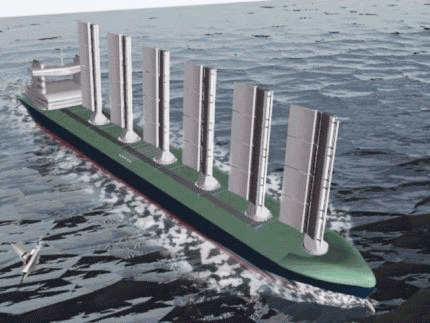
or a computerized modern sailing cargo vessel

Last edited by ghosthunter; March 5th, 2012 at 03:23 PM.
-
Tsikot Member Rank 4
- Join Date
- Nov 2005
- Posts
- 45,927
March 5th, 2012 04:46 PM #27if environmentalists had their way the human race will be set back 200 years
the last 200 years saw explosive growth and development
industrial food production fed billions of people
automobiles, air travel
mass production of goods, global supply chain
all possible coz humans burned oil
but environmentalists want the human race to go back to pre-industrial living
-
Tsikoteer
- Join Date
- Oct 2002
- Posts
- 29,354
-
 Tsikoteer
- Join Date
- Oct 2002
- Posts
- 10,819
March 5th, 2012 10:18 PM #29people don't buy electric cars for one very good reason: it only takes 5 minutes to fill up a near empty gas tank but it takes a whole day to charge those batteries. those people who buy electric cars have another one with a v12 engine in the garage (which they actually use everyday) and another suv with a v8 engine which they use on the weekends to pull their jetskis and boats. the elctric car is only for show.
-
SobrangBilisMagType!
- Join Date
- Aug 2004
- Posts
- 22,702
March 6th, 2012 11:39 AM #30Actually, the problem is, nobody wants to admit the truth. The only way to ensure the sustainable and long-term survival of the human species is to lower global population to well under a billion people. Originally Posted by uls
The Church doesn't like the idea. Capitalists don't like the idea. (Capitalism is predicated on perpetual growth... which is not possible within a resource-constrained system) Socialists don't like the idea. (Stinks of Eugenics) Populists don't like the idea.
Nobody will agree to not have children, or to have only one child for every six or seven couples.
The human race is primed to self-destruct. We stop breeding when we are well fed. We breed like rabbits when we starve. The natural forms of population control don't work in our case because we're smarter than nature.
Ang pagbalik ng comeback...
-
Tsikot Member Rank 4
- Join Date
- Nov 2005
- Posts
- 45,927
March 6th, 2012 12:13 PM #31coz man has beaten natural methods of population control -- famine, disease etc... man is no longer at nature's mercy
now you have billions of people alive and breeding that shouldnt be alive and breeding if left to nature's mercy
and here's the thing -- those billions of people all want to live like Americans (fastfood, SUVs)
as standard of living rises people consume more stuff (which means more stuff has to be made by factories that pollute)
people wanna acquire automobiles. even if only 10% of the 1.3 billion Chinese buy automobiles in the next 5 years that's 130 million automobiles added on top of the number of automobiles already out there (can oil producers supply the demand for oil?)
and as people move up from poverty they eat more meat -- so you have to produce livestock by the billions which produce lots of methane
HowStuffWorks "Do cows pollute as much as cars?"
(so environmentalists, do you eat burgers? bet you never thought of that. ang attention niyo kasi nasa cars lang)Cows emit a massive amount of methane through belching, with a lesser amount through flatulence. Statistics vary regarding how much methane the average dairy cow expels. Some experts say 100 liters to 200 liters a day (or about 26 gallons to about 53 gallons), while others say it's up to 500 liters (about 132 gallons) a day. In any case, that's a lot of methane, an amount comparable to the pollution produced by a car in a day.
To understand why cows produce methane, it's important to know a bit more about how they work. Cows, goats, sheep and several other animals belong to a class of animals called ruminants. Ruminants have four stomachs and digest their food in their stomachs instead of in their intestines, as humans do. Ruminants eat food, regurgitate it as cud and eat it again. The stomachs are filled with bacteria that aid in digestion, but also produce methane.
basically my point is this is a runaway train
like niky said, you have to bring down human population to bring back man-nature balance
but since man has conquered the natural methods of population control the only way to eliminate billions of people is mass extermination (which of course is unpopular)Last edited by uls; March 6th, 2012 at 12:31 PM.
-
 Moderator
- Join Date
- Nov 2010
- Posts
- 25,276
March 6th, 2012 12:19 PM #32That is why developed countries have very low to negative population growth! Originally Posted by niky
UNFPA - FACT SHEET: Population Growth and Poverty - lower fertility leads to lower poverty.
Fasten your seatbelt! Or else... Driven To Thrill!
-
Tsikot Member Rank 4
- Join Date
- Nov 2005
- Posts
- 45,927
March 6th, 2012 12:41 PM #33and for those who will say "the Chinese can buy electric cars"
"they have BYD making electric cars... Warren Buffett is an investor in BYD"
whatever
eto sagot ko:
http://europe.chinadaily.com.cn/epap...t_12504535.htm
China total vehicle sales 18.5 million units last year. how many electric cars is that? probably less than a thousandBYD's worst nightmare came true last year.
BYD, which stands for Build Your Dream, is known as the pioneer of electric vehicles in China. The company had high expectations for the F3DM and had hoped to sell up to 1,000 units.
Even combined with an incentive backed by the central government, the company sold fewer than 500 electric cars in 2010. The F3DM can switch between hybrid electric and electric modes, and can be charged at home using a 220v outlet.Last edited by uls; March 6th, 2012 at 12:44 PM.
-
 Social Dementia
- Join Date
- Sep 2003
- Posts
- 25,189
March 6th, 2012 12:51 PM #34If people are occupied with work in order to survive, having babies is not a priority. Originally Posted by Ry_Tower
-
Tsikot Member Rank 4
- Join Date
- Nov 2005
- Posts
- 45,927
March 6th, 2012 01:06 PM #35less educated people breed like rabbits coz they act on animal instinct. they have little self control. they don't think about consequences
educated people don't breed like rabbits coz they have more self control. they think about consequencesLast edited by uls; March 6th, 2012 at 01:48 PM.
-
Moderator
- Join Date
- Nov 2010
- Posts
- 25,276
March 6th, 2012 01:09 PM #36Kaya nga karamihan ng maperang tourist dito sa amin eh couples na mga 35-45 yrs old tapos walang anak. Originally Posted by Monseratto
Yan ang namimili ng south sea pearls (necklace, bracelets at hindi lang earrings) na hindi tumatawad! heheFasten your seatbelt! Or else... Driven To Thrill!
-
 Tsikoteer
- Join Date
- Jul 2011
- Posts
- 950
March 8th, 2012 02:51 PM #37I'd rather get an Aveo over a Volt. BTW what the tree-huggers conveniently forget when they talk about the miracles of electric drive is the batteries generate a lot of pollution to be manufactured. Also they're quite expensive to replace after 5 or 10 years...
-
SobrangBilisMagType!
- Join Date
- Aug 2004
- Posts
- 22,702
March 8th, 2012 03:22 PM #38The pollution inherent in making lithium ion or lithium polymer battery equipped cars isn't huge. That claim was for the nickel metal hydrides... and that was in relation to older mining methods which are no longer used.
Ang pagbalik ng comeback...
-
 Verified Tsikot Member
- Join Date
- Mar 2012
- Posts
- 37
March 19th, 2012 07:13 PM #39Oil companies have brought out all the companies making High tech batteries in the past. The Volt cost USA taxpayers 250K each in subsidies to the car company, the batteries explode and have to be replace which is another huge cost for the buyer, as fuel is set to double soon people will just drive less.
-
SobrangBilisMagType!
- Join Date
- Aug 2004
- Posts
- 22,702
March 19th, 2012 09:40 PM #40The subsidies aren't at 250k, they're not even a subsidy, just a 7.5k tax break. If you're talking about the loans, then that applies to all GM cars. As for battery exploding? That's a myth. That's only happened to batteries used in crash tests... Weeks after the crash... And the crash tests total the car, so the battery isn't the only thing needing replacement.
 Originally Posted by Mguy

 Reply With Quote